In this article
Ask the internet how long a water heater lasts and you get a range: ten to fifteen years for a tank, twenty or more for tankless. Those numbers are not wrong, but they describe a water heater somewhere in general. Yours is in Simcoe County, running on water that is harder than the national average, and that changes the arithmetic.
In the homes we service around Barrie, tanks that get no attention at all tend to fail between eight and twelve years. Tanks that get flushed and have the anode rod checked regularly go past fifteen without much drama. That is not a small difference. It is roughly half the life of the appliance, decided by an hour of maintenance a year.
This is worth reading in late summer, because water heaters overwhelmingly fail in cold weather. Incoming water temperature drops, the tank works harder, and whatever weakness had been quietly developing all year picks November to become your problem. Every autumn we take a run of no-hot-water calls from tanks that were, technically, fine in August.
What actually kills a tank
A conventional tank is a steel cylinder with a thin glass lining, full of hot water, permanently. Steel and hot water do not get along. The glass lining is what stands between them, and it is not perfect, because it has to have holes in it where the fittings go through and it develops microscopic flaws in normal use.
So the tank comes with a sacrificial anode rod. It is a length of magnesium or aluminium suspended in the water, and it is deliberately more attractive to corrosion than the steel is. As long as that rod is being eaten, your tank is not.
When the anode rod is used up, and in hard water that happens faster, corrosion moves on to the next available metal. That is the tank wall. Once the tank wall goes, there is no repair. You cannot patch the inside of a sealed steel cylinder, and nobody will try. That is why a leaking tank is always a replacement and never a fix.
Everything else about water heater lifespan is really a story about how fast you get to that point.
Hard water is the local factor
Water through this part of Simcoe County carries a lot of dissolved calcium and magnesium. You see it on kettles, on shower glass and on faucet aerators. What you do not see is what it does inside the tank.
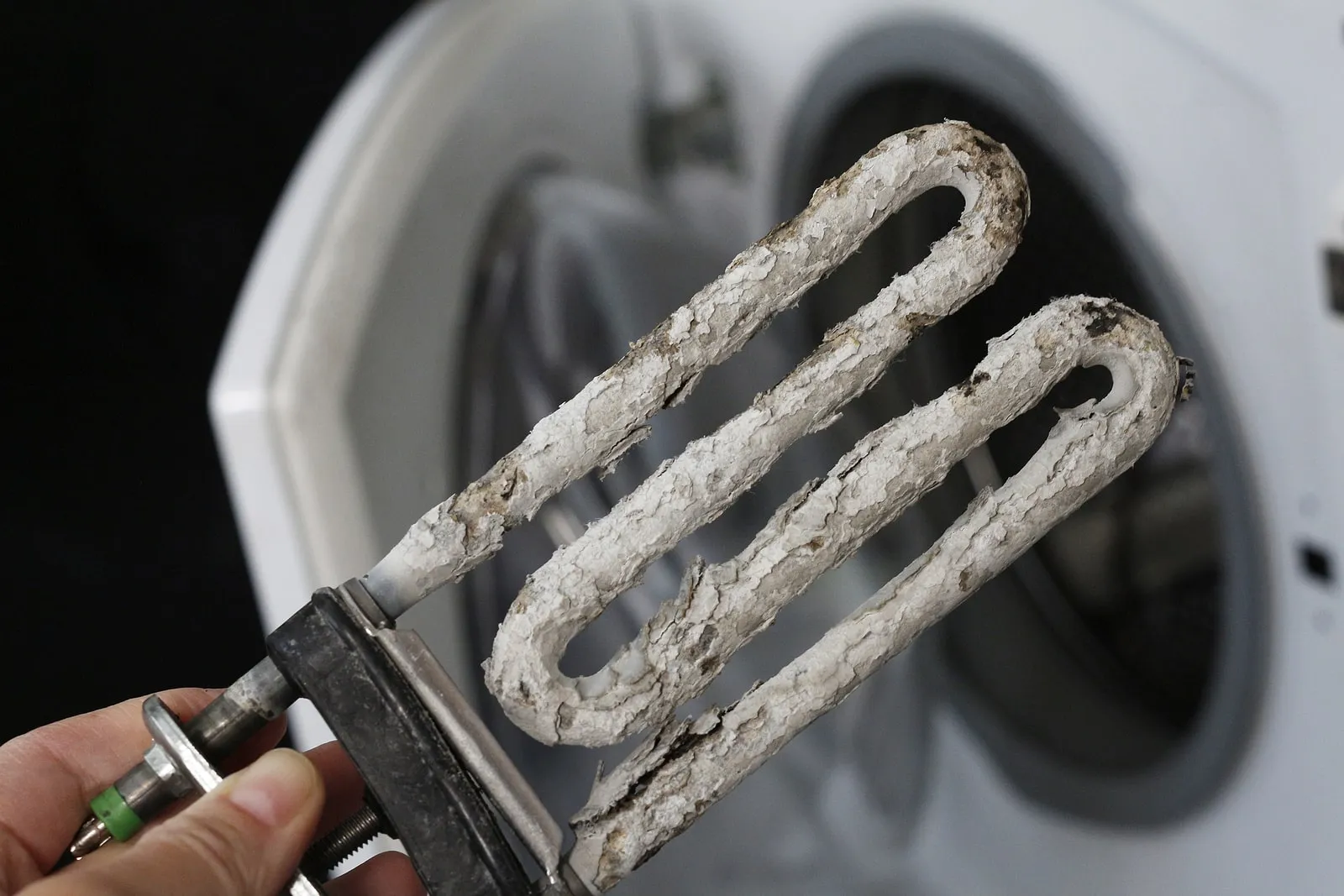
When hard water is heated, those minerals come out of solution and settle as scale on the bottom of the tank, directly on top of the burner or around the lower element. On a gas heater, that layer acts as insulation between the flame and the water. The burner runs longer to reach temperature, the steel at the bottom of the tank gets hotter than it was designed to, and the glass lining degrades faster. On an electric heater, scale builds directly on the element and burns it out.
Scale also eats the anode rod faster, which brings the failure point forward at both ends.
This is why a tank in a Barrie home without a softener behaves like an older tank than its age suggests, and why the single most useful maintenance job on this appliance is flushing the sediment out before it can bake into a hard layer.
The realistic numbers
For a conventional gas or electric tank in this area, plan on ten to twelve years with basic maintenance, and eight to ten without. Past twelve, you are on borrowed time and should be planning rather than reacting.
For a tankless unit, fifteen to twenty is realistic here, but with a firm condition attached: tankless units need descaling, and in hard water that means annually. A tankless that has never been descaled will not reach fifteen. It will start throwing error codes and delivering inconsistent temperatures well before that, and the heat exchanger is the expensive part.
Two other things shift the number. Recirculation systems, which give you instant hot water at distant taps, keep water moving through the tank constantly and shorten its life. And an undersized tank for the household runs a longer duty cycle every single day, which ages it faster than a correctly sized one.
How to tell where yours is on that clock
Start with the age, because most people do not actually know it. There is a serial number on the rating plate, and the manufacturing date is usually encoded in the first four characters, often as a letter for the month and two digits for the year, or as a week and year pair. If you cannot decode it, photograph the plate and we will tell you.
Then work through the signs, roughly in order of how urgent they are.
Rusty or brown hot water, where the cold runs clear, means corrosion inside the tank. If it were the supply, both taps would be discoloured. This one is late-stage.
A rumbling or popping sound during heating is water boiling underneath a layer of sediment and forcing its way through. It is the most common warning sign we hear about and the one most people ignore for years. It means the sediment layer is thick.
Water that runs out faster than it used to, without any change in household habits, usually means sediment has taken up volume that used to be hot water.
Water that never gets as hot as it did points at a failing element, a failing thermostat, or heavy scale on the burner surface.
Any moisture around the base of the tank is the end. A weeping seam does not reseal. Once you see water on the floor around a tank, arrange a replacement rather than a repair, and do it before it opens up properly, because a tank that lets go dumps its whole volume onto the floor.
If you are weighing up whether to repair or replace, we wrote a separate piece on exactly that call: repair or replace a water heater.
The maintenance that actually extends the life
Flush the tank annually. Hook a hose to the drain valve at the bottom, run it to a floor drain or outside, and let it flow until it runs clear. On a tank that has never been flushed and is well into its life, this is worth doing carefully, because sediment can be holding a corroded drain valve together, and a lot of people discover that the hard way. If your tank is older than eight years and has never been touched, have someone do the first one.
Check the anode rod every two to three years, more often on hard water. It sits under a hex plug on the top of the tank. If it is down to a wire core or heavily pitted, replacing it costs a fraction of a new heater and it directly buys years. This is the single highest-value maintenance item on the appliance and almost nobody does it.
Test the temperature and pressure relief valve once a year. Lift the lever, let it discharge briefly, let it snap shut. If it does not reseal, or if it discharges on its own, it needs replacing. This valve is the safety device that stops the tank becoming a pressure vessel, and a seized one is genuinely dangerous.
Set the thermostat to 60 degrees Celsius. Lower encourages bacterial growth in the tank. Higher accelerates scale, wastes energy and raises the scald risk at the tap. If you want lower temperatures at fixtures for safety, that is what a mixing valve is for, and it belongs at the tank rather than at the thermostat.
Consider a softener if your water is hard, which in most of this area it is. It is not a cheap purchase, but it pays for itself across the life of the water heater, the dishwasher, the washing machine and every fixture in the house.
Tank or tankless, when the time comes
When you do replace, the honest answer is that it depends on the house rather than on which technology is better.
Tankless costs more to install, particularly if the gas line needs upsizing or the venting has to be rerouted, which in a lot of older Barrie homes it does. In exchange you get endless hot water, a smaller footprint, lower standby losses and a longer service life, provided you commit to annual descaling. If nobody in the house will remember to do that, be honest about it now rather than in year seven.
A tank is cheaper to install, simpler to service, and completely fine for most households. If your existing venting and gas line suit a tank and the family's hot water demand is ordinary, replacing like for like is often the sensible choice and there is no shame in it.
The genuine arguments for tankless are a household that runs out of hot water regularly, a mechanical room where floor space is worth something, or a long planned stay in the house that lets the longer life and lower running cost pay back the install.
Whichever way you go, sizing matters more than the badge. An undersized tankless unit that cannot keep up with two showers in January will annoy you every winter for two decades. We size on peak simultaneous demand and on the incoming water temperature in the coldest month, not on the number of bathrooms.
What is worth repairing, and what is not
Not every water heater problem is the end of the appliance, and it is worth knowing which side of the line you are on before anyone quotes you a replacement.
Worth repairing: a failed thermostat, a burnt-out element on an electric unit, a thermocouple or igniter on a gas unit, a seized drain valve, a failed temperature and pressure relief valve, a spent anode rod, and in most cases a leaking connection at the top of the tank. All of those are parts on a sound tank, and on a heater under about eight years old they are straightforward economics.
Not worth repairing: the tank itself. If the steel has corroded through, that is it, whatever anyone tells you about epoxies or internal patches. A tank that is weeping at a seam or rusting at the base is finished. Also treat anything expensive on a heater past twelve years with suspicion, not because the repair will not work, but because you may well be paying half a replacement to buy eighteen months.
The awkward middle is a nine or ten year old tank with a repair that costs a meaningful fraction of a new unit. Our rule of thumb is straightforward: if the repair costs more than about a third of the replacement and the tank is past two thirds of its expected life, replace it. We will give you both numbers and let you make the call rather than steering you.
What a proper service visit involves
If you book a water heater service rather than a repair, it is fair to ask what you are actually paying for, because the quality of these visits varies enormously.
A real one includes draining and flushing the tank until the water runs clear, pulling and inspecting the anode rod, testing the temperature and pressure relief valve, checking the thermostat calibration against the actual delivered temperature at a tap, inspecting the venting on a gas unit for corrosion or backdrafting, checking the gas connection or the electrical connections for heat damage, and looking over the expansion tank if there is one.
That last one matters more than people expect. If your home has a backflow preventer or a pressure reducing valve on the incoming line, and most newer Barrie homes do, your plumbing is a closed system. Heated water expands and has nowhere to go, so pressure spikes every heating cycle. An expansion tank absorbs that. A failed or waterlogged expansion tank puts the whole system through a pressure cycle several times a day, which stresses the relief valve, the fittings and the tank itself. We covered the details in water heater expansion tanks.
A visit that consists of glancing at the tank and telling you it looks fine is not a service, and you should not pay for one.
Questions we get asked constantly
Can I flush the tank myself? Yes, if it has been flushed before and the drain valve is in good condition. If the tank is old and has never been flushed, get someone who is prepared for the drain valve to fail, because that turns a maintenance job into an emergency very quickly.
Does turning the temperature down make it last longer? A little, but 60 degrees is the floor for safety reasons and going below that trades a bacterial risk for a marginal gain. If you want it cooler at the tap, a mixing valve does that properly.
My hot water smells like rotten eggs. Is the tank finished? Usually not. That smell is a reaction between the anode rod and sulphur bacteria in the water, and it is far more common on wells than on municipal supply. Changing the anode type and sanitising the tank normally solves it. It is a nuisance, not a death sentence.
The pilot keeps going out. Is that the tank? Almost always a thermocouple, which is an inexpensive part. If a new thermocouple does not hold it, look at venting and combustion air before anyone talks about replacing the heater.
Is a leak from the relief valve pipe serious? It means something is discharging, and the two usual reasons are excess pressure in a closed system, which points at the expansion tank, or a relief valve that has failed to reseal. Either way it needs looking at rather than capping. Never plug that pipe.
How long does a replacement take? A like-for-like tank swap is typically a half day. Anything that changes the fuel, the venting or the location takes longer, and a first tankless install is usually a full day or more depending on the gas line and venting work.
Where the money goes
Rough shapes rather than quotes, because the house decides a lot of this.
An anode rod replacement is the cheapest thing on this list by a wide margin and the one that buys the most life. An annual flush and service is the next tier and is normally the best value maintenance spend in the whole mechanical room. Element, thermostat and thermocouple repairs sit in similar territory and are usually single-visit jobs.
A like-for-like tank replacement is the main event for most households, and the range comes down to capacity, fuel and whether the venting or connections need bringing up to current code, which on an older install they sometimes do. A tankless conversion sits above that, and the spread is wide because the gas line and venting work varies enormously between houses.
Everything is priced flat rate and approved before we start, and if the honest answer is that your tank has three good years left, that is what you will hear. Ordinary plumbing repair work on a sound tank beats selling somebody a heater they did not need.
Do not let it fail in January
The pattern is consistent enough to plan around. Incoming municipal water in Barrie is far colder in winter than in summer, so the heater does considerably more work per litre from November onward. A tank that is already marginal, with heavy scale and a spent anode rod, meets that extra load and quits.
Which is why we would rather see a twelve-year-old tank in September than in January. A planned replacement is a booked morning, at a normal rate, with the unit you chose. An emergency replacement is a cold shower, whatever equipment is on the truck, and possibly whatever the water did to the floor on its way out.
If yours is over ten, get it looked at before the cold. If it is over twelve, budget for the replacement even if it is still working, because the odds are no longer in your favour.
Get a straight answer on yours
We service, repair and replace tank and tankless units across Barrie, Innisfil, Angus, Alliston, Bradford, Orillia and the surrounding towns. If you want to know honestly where yours stands, book a look at our water heater services or call 249-535-3789. If it has years left, we will tell you that and flush it while we are there. If it does not, you will get the number before the cold weather makes the decision for you.
About the author

Plumbify Team
Licensed plumbers in Barrie, ON. Owner-operated since 2007, working in Simcoe County homes every day.
Written from real service calls
Need a plumber in Barrie?
Same-day service, 6 AM to 9 PM, 7 days a week.