In this article
The call usually comes in the same way. Someone ran the washing machine, or took a long shower, and water came up through the floor drain in the basement. Sometimes it is clean water. Often it is not. Either way the panic is the same, because water coming up out of the floor feels like the house has gone into reverse.
Here is the first thing worth saying: a basement floor drain backing up is almost never a problem with the floor drain. The floor drain is the lowest opening in your plumbing system, which makes it the first place water shows up when something further down the line cannot take it. It is the messenger. The actual fault is somewhere between that drain and the city main, or in the case of a lot of Barrie homes, in the ground outside your foundation wall.
This article walks through what is really going on, how to tell the causes apart, what you can do in the moment, and which of the permanent fixes are worth the money.
The one distinction that changes everything
Before anything else, work out whether the backup happens when you use water, or whether it happens when it rains.
If the drain backs up when you run the washing machine, flush a toilet or empty a tub, the problem is inside your own drainage system. Something between your house and the city main is restricted, and your own wastewater has nowhere to go.
If the drain backs up during heavy rain or spring melt, when nobody in the house has touched a tap, the water is coming the other way. The municipal system is surcharged, and the path of least resistance for that water runs back up your lateral and out of your floor drain.
Those two situations look identical from where you are standing, in an inch of water with a mop. They have almost nothing in common as repairs. So before you call anyone, take thirty seconds and think about what was happening in the house when it started, because that single detail sends the diagnosis in completely different directions.
Cause one: the lateral is blocked
The pipe running from your house to the city main is called the lateral, and it belongs to you, not the city. In older parts of Barrie, the Allandale streets, the blocks around the downtown core, the neighbourhoods that went in before the 1970s, a lot of those laterals are clay, laid in short sections with joints between them.
Clay holds up remarkably well against water. What it does not hold up against is trees. Every root within reach of a leaking joint will find it, get in, and keep growing, because inside that pipe is exactly what a root wants. Over a few years the root mass builds into something like a filter across the pipe. Water gets through. Solids do not. Then one day the filter blocks, and the lowest opening in your house starts filling.
The tell for a root blockage is the pattern. It clears when someone snakes it, works fine for six or eight months, then does the same thing again, usually around the same time of year. Every clearing buys you another season. That is not a coincidence and it is not bad luck, it is the roots growing back at the rate roots grow.
Grease is the other common blocker, and it builds differently. Grease coats the inside of the pipe in layers, narrowing it gradually, and it collects everything fibrous that passes through. Wipes are the usual accomplice, including the ones sold as flushable. We pull them out of laterals constantly. They do not break down the way toilet paper does, and once one catches on a rough joint it starts collecting everything behind it.
If you are dealing with repeat backups, drain cleaning that includes a camera run is worth far more than another snake. A snake makes a hole through the blockage. A camera tells you whether you are dealing with roots, grease, a collapsed section or a belly in the pipe, and those four have four different answers.
Cause two: the lateral has failed structurally
Sometimes the pipe itself has given up. Clay sections shift and separate, cast iron rots out from the inside, and older plastic can flatten under a driveway that has taken heavier vehicles than anyone planned for. There is also the belly, a low spot where the ground under the pipe settled and left a dip that holds standing water.
A belly behaves like a slow blockage that nobody can clear, because there is nothing to clear. Waste settles in the low spot, builds up, and blocks. You snake it, it works, it fills again. The only real fixes are to dig and re-lay that section at a proper grade, or to accept it and put the line on a cleaning schedule.
This is where a camera pays for itself. Guessing at a structural problem is expensive, because the repairs are excavation-sized. Seeing it on screen before anyone quotes means you are making a decision about a real thing, not a theory. Our sewer line services start with the camera for exactly that reason.
Cause three: the city main is surcharged
This is the rain-driven version, and it is a different animal entirely, because nothing in your house is broken.
During a heavy storm or a fast spring melt, the volume going into the municipal sanitary system can exceed what it was built to carry. Water that cannot move downstream backs up through the network. Your lateral is a branch off that network, and your floor drain is the lowest opening on your branch. So it comes out there.
You will often hear about this happening to whole streets at once, and that is the giveaway. If your neighbours flooded the same night, nobody on the street has a blocked lateral. The system was overwhelmed.
Two things contribute to how bad this gets. One is inflow, which is stormwater getting into the sanitary system where it should not be, through cracked laterals, illegally connected downspouts and old weeping tile connections. The other is simply intense rainfall on ground that is already saturated, which Simcoe County gets more of than it used to.
The fix for a surcharged main: a backwater valve
If your backups are rain-driven, no amount of drain cleaning will help. What you need is a backwater valve, sometimes called a backflow valve or a mainline check valve.
It is a simple device. It sits in the lateral, usually in a small pit cut into the basement floor near where the pipe leaves the house, and it holds a flap that swings open to let your wastewater out. When water tries to come the other way, the flap is pushed shut. Sewage from the street physically cannot get past it.
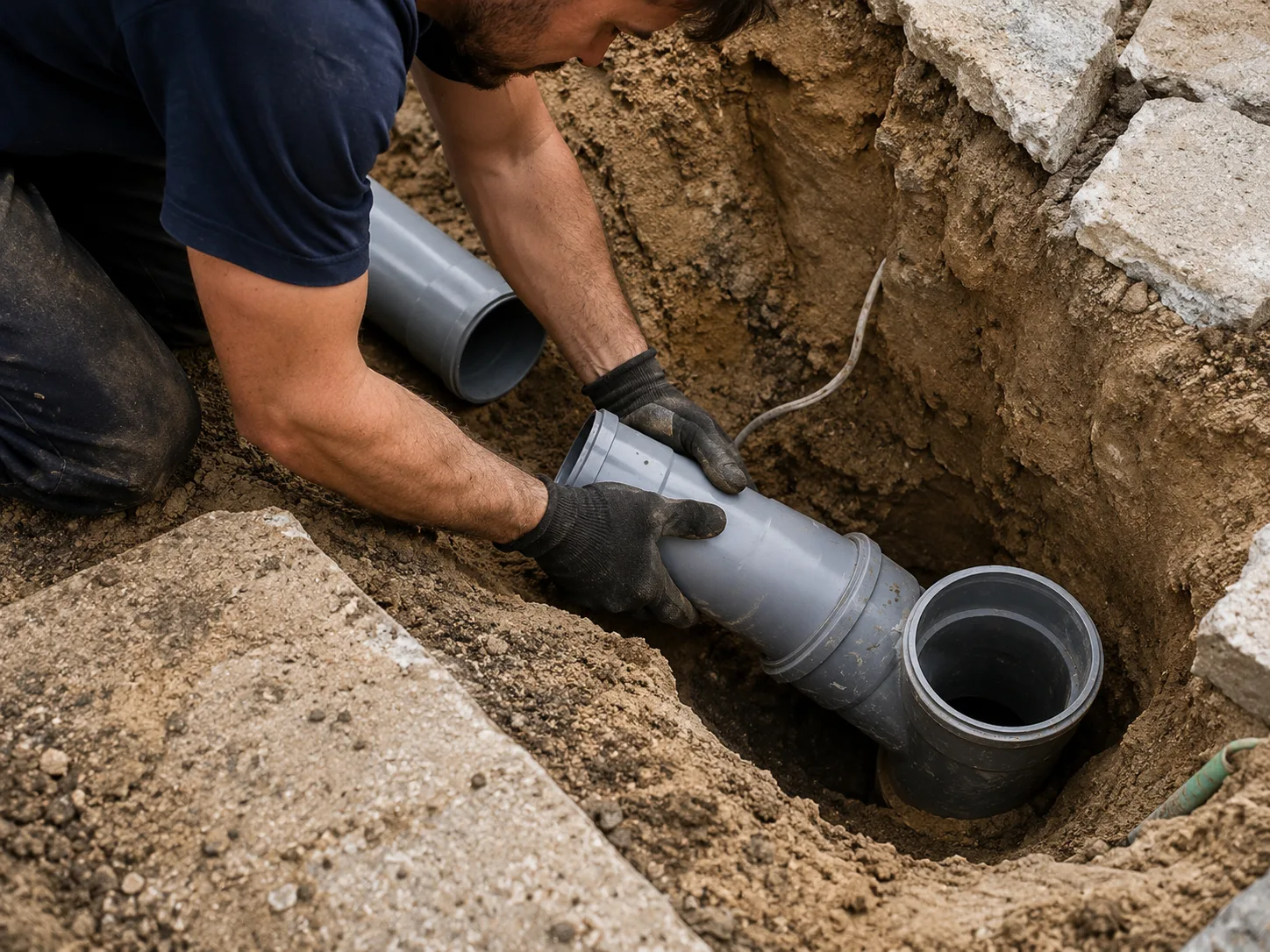
Installing one means cutting the basement floor, exposing the lateral, cutting in the valve body, backfilling and patching the concrete. It is a real job, usually a day, and it needs a permit and an inspection. It is also the only thing that actually solves rain-driven backups, which is why municipalities across Ontario have subsidised them at various points. Check whether Barrie has an active grant before you book, because these programs come and go and the paperwork usually has to be filed before the work starts, not after.
The one thing to understand about a backwater valve is that while it is closed, your house cannot drain either. During a bad storm, that means not running the washing machine and going easy on the toilets until the street system catches up. That is a fair trade against a basement full of sewage, but it is worth knowing rather than discovering.
What about the sump pump?
Sump pumps and floor drains get confused constantly, and they do two unrelated jobs.
The sump pump handles groundwater. Weeping tile around your foundation collects water in the soil and carries it to the sump pit, and the pump lifts it out and away from the house. That is a storm and groundwater system.
The floor drain handles wastewater, and it connects to the sanitary lateral, the same one your toilets use. Different pipe, different destination.
So a failed sump pump floods your basement with clean groundwater, usually starting near the pit or along the foundation walls. A blocked lateral pushes wastewater up through the floor drain, which is normally somewhere near the middle of the floor. Where the water first appeared tells you which system is at fault, and it is worth noticing that before you start mopping.
What to do while it is actually happening
Stop using water. Every fixture in the house drains to the same lateral, so a shower running upstairs is adding to what is coming up in the basement. Tell everyone in the house, because this is the step people skip.
Keep out of the water if it is sewage. It carries bacteria that you do not want on your skin or in a cut, and if it has risen anywhere near an electrical outlet, a furnace or a panel, treat the basement as unsafe and shut the power to it off at the breaker if you can do that from a dry position. If you cannot, leave it and call an electrician.
Do not pour drain cleaner down the floor drain. In a lateral blockage it will not reach the problem, it will sit in standing water, and it will still be there and still caustic when somebody has to work in it. On a blocked main line it does nothing useful at all.
Photograph everything before you clean up. Insurers want to see the water, its extent, and what it touched. Take more pictures than you think you need, including the drain itself and any belongings in the water.
Then get someone out. If sewage is still rising or you cannot use any plumbing in the house, that is what emergency plumbing exists for. We are out every day from 6 AM to 9 PM across Barrie, Innisfil, Angus and the rest of the county, and on this particular problem, speed matters because the damage compounds by the hour.
How we actually diagnose it
There is a fairly standard sequence, and it is worth knowing what to expect so you can tell whether the person in your basement is diagnosing or guessing.
First, questions. When does it happen, what is running when it does, has it happened before, when was it last cleared, how old is the house, are there mature trees between the house and the street. That conversation narrows it down more than most people expect.
Second, we find the cleanout, which is the capped access point on the lateral. If the cleanout is dry and the floor drain is full, the blockage is upstream, between the drain and the cleanout. If the cleanout is full, it is downstream, out toward the street. That single check splits the problem in half.
Third, we clear enough to restore flow, because you need to be able to use your house.
Fourth, and this is the part that gets skipped by the cheapest quote, we put a camera down the cleared line. That is what tells you whether you just paid to postpone the same backup, or whether the line is genuinely sound and something one-off caused it. Roots, a belly, a separated joint and a grease build-up all look completely different on screen, and you should see the footage yourself before anyone quotes a repair.
What it costs, roughly
Numbers vary with access, severity and how much of the line needs work, so treat these as the shape of the thing rather than a quote.
Clearing a blocked main line is the smallest of them, and it is usually a single visit. Adding a camera inspection to that visit costs less than booking it separately later, and it is the difference between fixing the problem and renting a solution for eight months.
Hydro-jetting, which scours the pipe wall rather than punching through the blockage, costs more than snaking and lasts considerably longer on grease and root work. On a line with recurring problems it is usually the better value.
A backwater valve is a permit-and-excavation job and prices accordingly, and any municipal subsidy that is running comes off that. A spot repair on a collapsed section means excavation, and the cost turns mostly on depth and what is on top of the pipe. Under a lawn is one number. Under a finished driveway is another.
We price every job flat rate and get it approved before starting, so what you agree to is what you pay. If you want an idea of the range for your situation before anyone comes out, say so on the phone and we will talk through it honestly, including when the answer is that you need a camera before anyone can responsibly quote.
Keeping it from happening again
If it was roots, the choices are a cleaning schedule, usually annual before the wet season, or a permanent repair to the section the roots are entering. Lining the pipe seals the joints without digging up the yard, and it costs more up front and less over ten years.
If it was grease and wipes, that is behavioural. Nothing goes down the toilet except what came out of you and toilet paper. No wipes, regardless of the packaging. Grease goes into a jar and into the bin, not down the sink with hot water behind it, because it cools and hardens twenty feet along the pipe where you cannot see it.
If it was a belly or a failing section, you are choosing between a repair now and a cleaning schedule indefinitely. There is a real argument for the schedule if the section is deep and expensive to reach, and we will tell you when that is the sensible call.
If it was the city main surcharging, it is a backwater valve, and it is worth doing before the next big storm rather than after.
In all four cases, put a lid on the floor drain trap and keep it primed. A dry trap lets sewer gas into the basement, and the smell that people describe as coming and going in the basement is usually exactly that. Pouring a jug of water down the floor drain every couple of months takes ten seconds and solves it.
If it is happening right now
Stop using water, stay out of it if it is dirty, and call us at 249-535-3789. Plumbify clears blocked main lines, cameras them properly, and installs backwater valves across Barrie, Innisfil, Angus, Alliston, Bradford, Orillia and the surrounding towns, every day from 6 AM to 9 PM.
About the author

Plumbify Team
Licensed plumbers in Barrie, ON. Owner-operated since 2007, working in Simcoe County homes every day.
Written from real service calls
Need a plumber in Barrie?
Same-day service, 6 AM to 9 PM, 7 days a week.