In this article
Most of the leaks that do real damage are not the ones you can see. A dripping tap is annoying and cheap. A supply line weeping inside a wall cavity, under a slab or above a finished basement ceiling is neither, because by the time it announces itself it has usually been running for months.
The good news is that a hidden leak is one of the few plumbing problems you can confirm yourself, at home, with no tools, in about two hours. You will not find out where it is, but you will find out with near certainty whether one exists, and that is the question worth answering first.
The two hour test that settles it
Every water meter has a leak indicator. On older mechanical meters it is a small triangular or star-shaped dial that spins when water is moving. On newer digital meters it is a dripping tap icon or a flow reading.
Turn off every water-using thing in the house. Taps, obviously, but also the dishwasher, the washing machine, the ice maker in the fridge, the humidifier on the furnace, and any irrigation. Tell everyone in the house not to flush.
Go and look at the meter. Note the exact reading, including the small digits. If the leak indicator is moving at all while nothing is running, you have a leak and you are done, that is the answer.
If it is not moving, the leak may be too small to spin it. So leave the house untouched for two hours and read the meter again. If the number has moved, water went somewhere.
This test costs nothing and it is the single most useful thing a homeowner can do before calling anyone. If you tell us the meter moved 40 litres in two hours with everything off, we start the visit knowing what we are looking for.
Narrowing it down: inside or outside
If the meter test is positive, there is one more thing you can do that saves time.
Find your main shut-off valve, usually in the basement near where the water enters the house, and close it. Then read the meter again, wait an hour, and read it once more.
If the meter is still moving with the main closed, the leak is on the line between the meter and the house shut-off, which means it is outside, underground. That is a different job and a more urgent one.
If the meter stops with the main closed, the leak is inside the house. That is the more common outcome and the easier one.
The signs, in the order they usually appear
A water bill that jumped without a reason. Compare against the same quarter last year rather than last quarter, so you are not confusing a leak with summer watering. A steady climb over three bills is a slow leak getting worse.
The sound of running water when nothing is running. Stand still in a quiet house late at night. People dismiss this because they assume they imagined it. Usually they did not.
A warm patch on a floor. This one is specific and it means a hot water line under the slab or under the subfloor. If part of a floor is noticeably warmer than the rest and it stays that way, take it seriously.
Musty smell in one room. Not the whole basement, one room, or one corner. Mould needs about 48 hours of moisture to start, so a persistent localised smell means persistent localised water.
Staining or a soft spot on drywall or ceiling. By the time it shows on the surface the cavity behind it has been wet for a while. Press it gently. Soft means saturated.
Paint or wallpaper bubbling, or baseboards separating. Wood swells before it stains.
Pressure that has dropped across the whole house. Not one tap, all of them. One tap is an aerator. All of them is supply.
Cracks appearing in a foundation wall or a floor slab, or an area of lawn that is greener and softer than the rest. Both point outside.
What causes them here
A few patterns come up repeatedly in Simcoe County homes.
Hard water. Water through this area carries a lot of dissolved mineral, which scales up inside pipes and fixtures. Scale narrows the bore, raises velocity and pressure, and accelerates wear at joints and valve seats. It is the quiet contributor behind a lot of leaks that get blamed on age alone.
Freeze and thaw. A pipe that froze slightly one winter, without bursting, can develop a hairline split that only weeps under pressure. Homeowners who had a scare two winters ago and thought they got away with it sometimes did not.
Ground movement. Soil here freezes deep and moves, and anything rigid running through it takes the strain, particularly older joints.
Kitec. Homes built roughly 1995 to 2007, which covers a lot of the Newmarket and Bradford subdivisions, may have Kitec pipe with brass fittings that corrode from the inside and fail without warning. If your visible pipe is grey and orange plastic, get it identified.
Water heaters. A tank that is weeping at a seam looks like a floor leak until you find the source. Always check around the base of the heater before assuming a pipe.
Toilets. A worn flapper leaks silently into the bowl and can waste hundreds of litres a day with no sound and no visible water. Put a few drops of food colouring in the tank, wait twenty minutes without flushing, and check the bowl. Colour in the bowl means the flapper is leaking. This is the single most common cause of an unexplained bill and it is a ten dollar part.
Why we do not just start opening walls
The old approach to a hidden leak was to work out roughly where it was and start cutting. That finds the leak eventually, and it also means drywall repair, paint, and sometimes tile, on top of the plumbing.
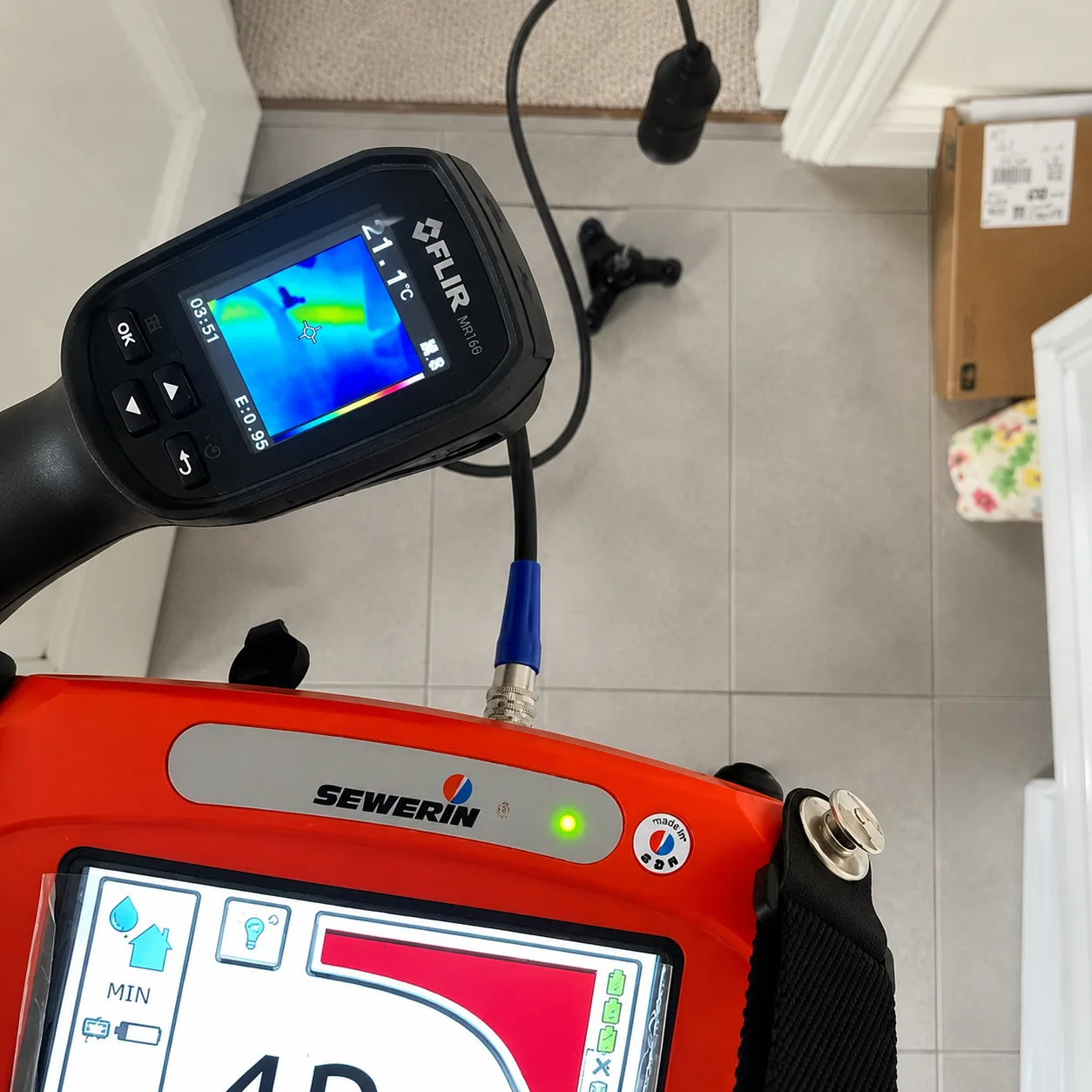
Modern leak detection is about locating the leak precisely before anything gets opened. Acoustic equipment picks up the sound of water escaping under pressure through the structure, and on a pressurised line that sound is distinctive enough to trace to a point. Thermal imaging shows temperature differences through surfaces, which finds hot water leaks quickly and cold ones by the evaporative cooling they cause. Pressure testing isolates sections of the system to prove which one is losing water. Tracer gas, for the awkward cases, is introduced into an isolated empty line and detected where it surfaces.
The point of all of it is the same: open one small area in the right place rather than several in the wrong ones. On a slab leak that difference is most of the cost of the job.
When it is the drain rather than the supply
Everything above assumes a pressurised supply leak, which is what the meter test detects. Drain leaks behave differently and the meter will not see them, because a drain only carries water when something upstream is running.
The signs are different too: a smell rather than a sound, damp that appears after someone showers and dries out in between, staining on a ceiling directly under a bathroom.
Underground drain leaks are their own category, and they are usually found with a camera rather than acoustically. A separated joint or a cracked section lets water into the surrounding soil, and over years that washes out the bedding under the pipe and makes the problem worse. If your symptoms are drain-related rather than supply-related, a camera run through the line is the right first step, and our sewer line services page covers what that involves.
Where leaks actually start, room by room
If you are trying to narrow it down before calling, this is roughly where we find them, in order of how often.
Under kitchen and bathroom sinks. Supply stops, the flexible connectors to the tap, and the trap. The connectors are the ones people forget: braided stainless lines have a service life and they fail at the crimp. Anything over ten years old is worth replacing on principle, because they fail suddenly rather than gradually.
Behind and under toilets. The supply connector, the fill valve, and the wax seal at the base. A failing wax seal shows as a floor that flexes slightly or a smell that comes and goes, and it rots the subfloor quietly for a long time before anything is visible.
Behind the shower or tub wall. The valve body and its connections sit inside the wall, so a weep there goes into the cavity. The tell is damp on the other side of that wall, in the adjacent room or hallway, rather than in the bathroom itself.
At the water heater. Connections at the top, the temperature and pressure relief discharge, the drain valve, and the tank seam. Always eliminate the heater before chasing pipe.
At the washing machine. The hot and cold hoses. Rubber ones should be replaced every five years and swapped for braided stainless, because a burst washing machine hose is one of the highest volume failures a house can have.
In the basement ceiling and rim joist area. Where a supply line runs above a finished ceiling, a slow weep can travel along the pipe or the joist and show up metres from the actual leak. This is the classic case for acoustic location rather than guessing.
Outside, between the meter and the house. Rare but expensive. The signs are a soft or unusually green patch of lawn, a drop in pressure across the whole house, and a meter that keeps moving with the main shut off.
What we actually do on the visit
Worth knowing so you can tell diagnosis from guesswork.
We start with your information: the meter readings, the bills, where you have noticed things. Then we confirm the leak is real and pressurised, usually by repeating the meter test properly with the house isolated.
Then we isolate. The house gets split into sections at the shut-offs, and each section is pressure tested in turn to find which one is losing. This narrows a whole-house problem down to a run of pipe before any listening starts, and it is the step that saves the most time.
Then we locate within that run. Acoustic equipment on the pipe and on surfaces, thermal imaging across floors and walls, and tracer gas if the first two do not resolve it. On a slab leak we will normally use two methods and make them agree before recommending anyone opens concrete.
Then we mark the spot, tell you what the repair involves, and price it before we start. If the repair means opening a wall or a floor, you will know exactly how much and where before anything is cut.
Stopping the next one
Know where your main shut-off is, and turn it once a year. A valve that has not moved in fifteen years often will not move when you need it to. Exercising it keeps it working and tells you now, rather than during a flood, if it needs replacing.
Check your water pressure. Above about 550 to 600 kPa (roughly 80 psi) is hard on every fitting, valve and appliance in the house, and it shortens the life of all of them. A gauge that screws onto an outside tap costs very little. If it reads high, a pressure reducing valve solves it permanently.
Replace flexible connectors on a schedule rather than on failure. Under sinks, at toilets, at the washing machine.
Deal with hard water. A softener protects far more than the water heater. Scale is a contributing factor in a large share of the fitting failures we see in this area.
Put leak sensors where it matters. Beside the water heater, under the washing machine, under the kitchen sink and in the sump pit. They cost very little and they turn a catastrophe into a phone call. If you are away from the house often, a whole-home shut-off valve that closes automatically on detection is worth the money.
If you leave in winter, do not turn the heat off. Keep it at 15 degrees or higher and have someone check the house, which many policies require anyway. A house with nobody in it is where a small leak becomes a total loss.
What it costs to ignore
Water damage is expensive out of proportion to the leak that caused it. A pinhole weeping into a wall cavity does not cost much in water. It costs in the drywall, the insulation, the framing and, if it has been going long enough, the remediation.
Insurance is the other consideration and it is worth being clear-eyed about. Policies generally cover sudden and accidental water damage. They generally do not cover damage from a leak that has been going on gradually, on the reasoning that the homeowner should have noticed. The line between the two is exactly where these claims get argued, and the longer a leak has run, the worse your position.
There is also the compounding effect. Wet framing invites mould within days. Saturated insulation stops insulating and never fully recovers. A slab leak washes out the material under the slab. Each of those turns a plumbing repair into a larger repair.
What to do right now
If the meter test came back positive and you can see or smell water, shut the main off and call. If the meter test was positive but nothing is visible, you have some time, but not months.
Before we arrive, it helps to have three things ready: the meter readings you took and the times, your last two or three water bills, and a list of anything you have noticed and where. That last one matters more than people expect. The room, the wall, the time of day, whether it correlates with anyone showering. Half of leak detection is knowing where to start listening.
And check the toilets with food colouring first, because if that is the answer, it is a ten dollar fix and nobody needs to come out.
Get it found properly
We locate and repair hidden leaks across Barrie, Innisfil, Angus, Alliston, Bradford, Orillia, Newmarket and Wasaga Beach, without opening walls at random. Call 249-535-3789, or read more about how we approach leak detection.
About the author

Plumbify Team
Licensed plumbers in Barrie, ON. Owner-operated since 2007, working in Simcoe County homes every day.
Written from real service calls
Need a plumber in Barrie?
Same-day service, 6 AM to 9 PM, 7 days a week.